As you get older, you find yourself visiting places you wouldn’t even have thought of ten years ago. In recent years, these have increasingly been spa towns.
Health resorts hold a peculiar fascination for me. They are like time capsules where, for example, you can see independent shops from sectors that are now almost entirely dominated by chains in cities. At the same time, the effects of the dismantling of the welfare state are often evident. In the late 1990s, the number of preventive care and rehabilitation facilities peaked; since then, the number of clinics and beds has been declining (as shown in the graph). And even though the sector is in decline, spa operations have been and remain a source of income, just like tourism. As a result, spa towns usually have a stronger local economy than other towns of a comparable size. This leads to a healthier local retail sector and also to architecture that is more impressive than average.
This weekend we went to Bad Nenndorf for a family trip to the State Garden Show (German). Although that’s not what this is about, just to say:
- The maze was a disappointment.
- They could have fitted every drinks stall with a coffee machine.
On the way back to the station, this relief caught my eye:
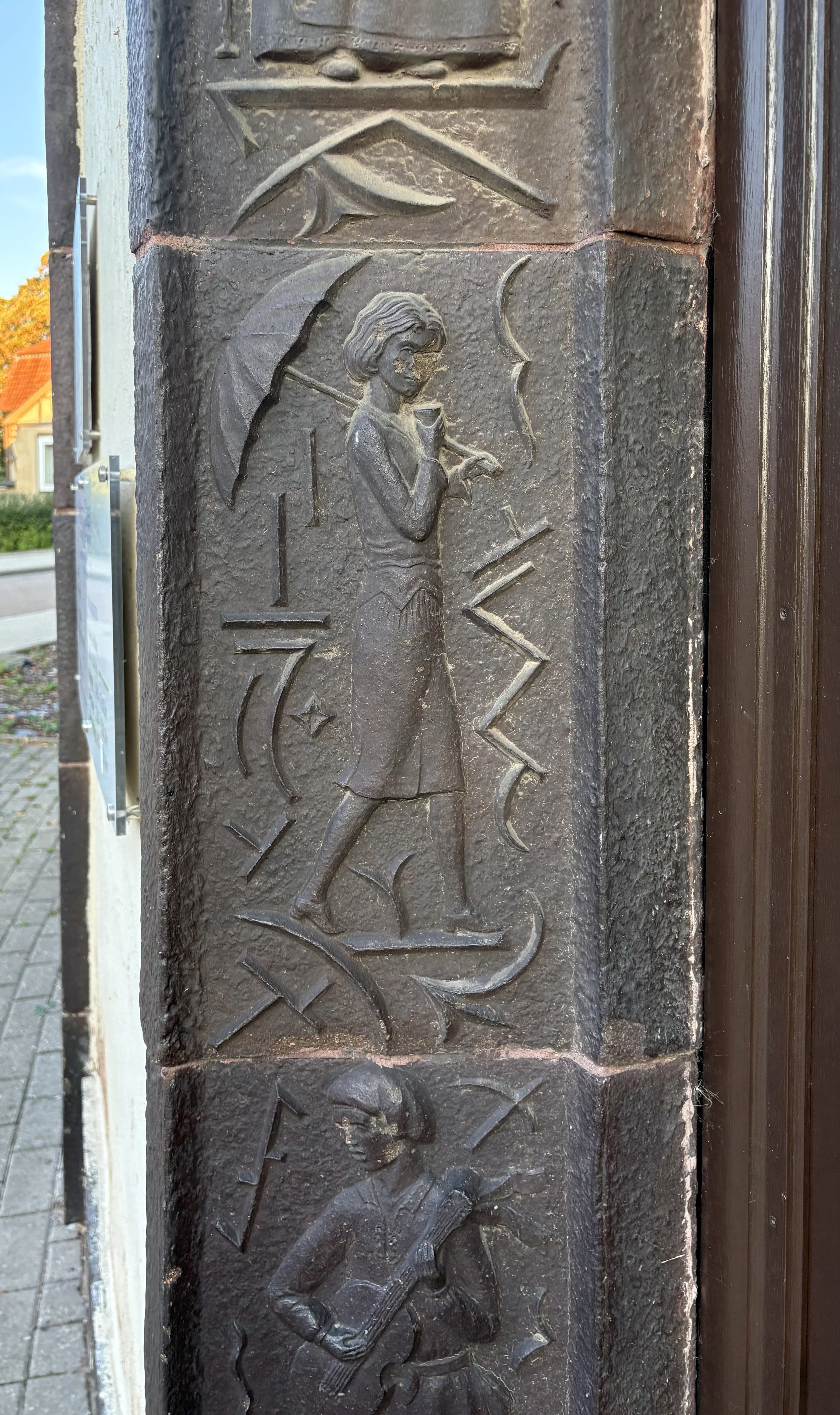
Woman with an umbrella in a frieze at the Wincklerbad
It forms part of the entrance to the Wincklerbad (German) (in the Lower Saxony Monument Atlas (German)), built in 1930. Due to low occupancy rates in 2007, the former spa facility was sold and converted.
And I remembered that I had seen a few less conspicuous façade ornaments from this period (1920–1930) in the city. Back then, ornaments featuring geometric or at least abstract shapes and jagged edges were all the rage. They can be attributed to the Art Deco style of the 1920s. Bettina Vaupel published an overview article in Monumente Online in April 2012 (German).
As I was already on my way back, there are no photos of my own here, only views from Google Street View.
Hidden
Location: Rodenberger Allee 1,
This ornament is rather hidden and only visible from a side street. The arrangement and the surrounding marble wall with rounded edges are also very unusual. The arrangement is most likely not original. It is possible that the reliefs were removed prior to a refurbishment or renovation and arranged in this way so that they could continue to be displayed.
Transformed beyond recognition
Location: Buchenallee 13
Apart from the ornate entrance, this building, too, looks considerably newer, perhaps dating from the 1990s. If it was a conversion, then the alterations were far more extensive than in the previous example, as can be seen from the window lintels.
As both buildings are likely to have strayed considerably from their original form, they are probably not listed as Architectural monuments.
Another mystery
But then I saw this building.
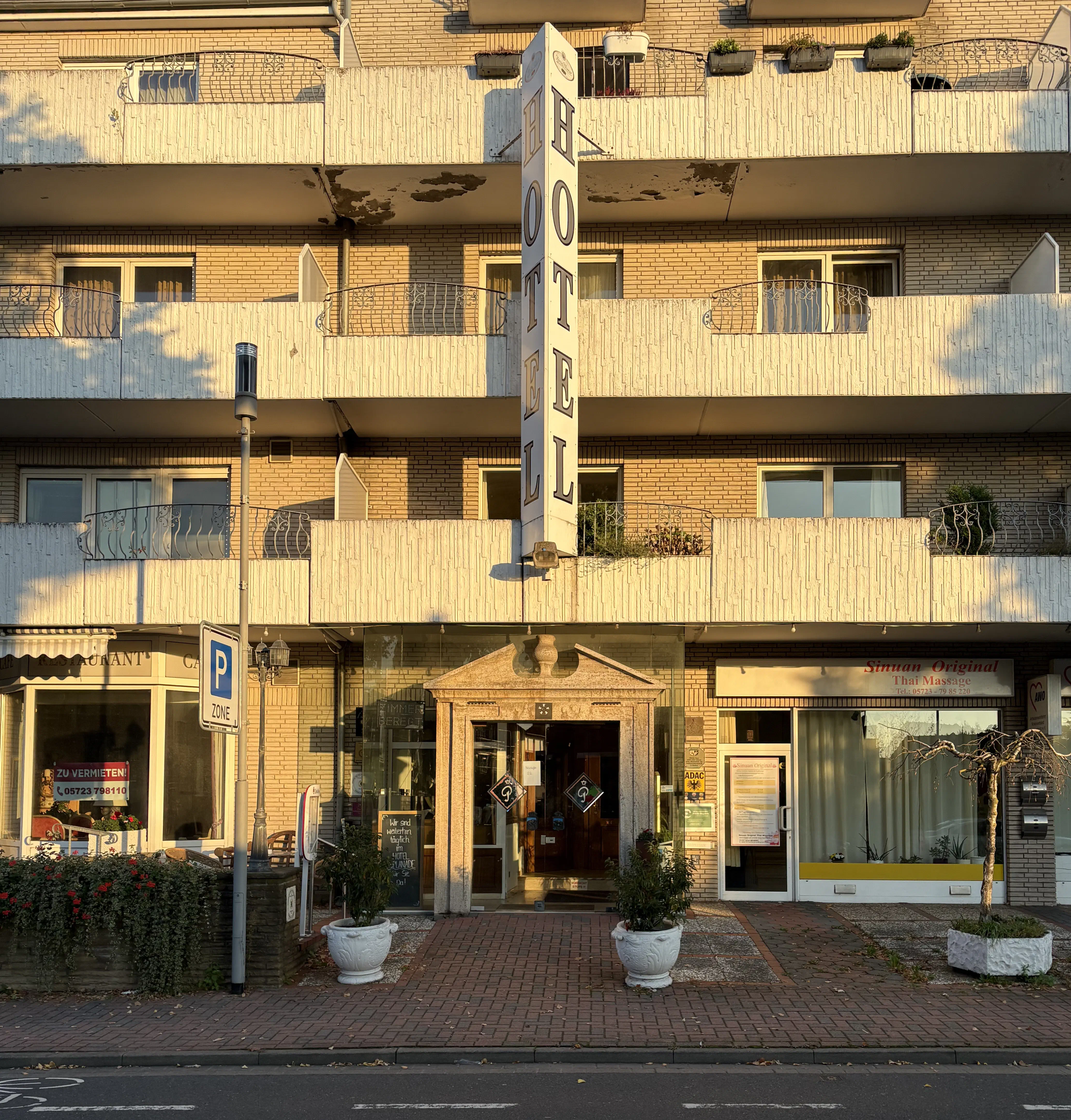
A historic sandstone portal in front of a glass passageway
Location: Parkhotel Deutsches Haus, Bahnhofstraße 22
And that’s when I asked myself: “Could it be that architectural style elements are simply being recycled in Bad Nenndorf?”
More
Hindenburgstraße begins across from the Parkhotel Deutsches Haus. The buildings at numbers 2 through 10 feature authentic Art Deco facade elements.
Epilog
There are numerous illustrated books and publications on the architecture of spas and health resorts, but for the 20th century (particularly the second half), there has been rather little so far…